


SPECIALIZATIONS
Acupuncture
Medical acupuncture, performed by a doctor with the ASA certificate.
At Medical Center Sorengo acupuncture is performed by a doctor: Dr. med. Nerlep Kaur Rana, FMH specialist in Anaesthesiology with the Swiss certificate in Acupuncture and Chinese Medicine (ASA). We use it where research shows it works, above all for chronic pain, headache and nausea, always after a consultation that establishes where the problem comes from. It is covered by Swiss basic health insurance.
At a glance
- What for: chronic back and neck pain, sciatica, osteoarthritis, tension-type headache and migraine, nausea after surgery or during cancer treatment.
- Who performs it: an FMH specialist doctor with the ASA certificate.
- Cost: covered by basic health insurance (KVG/LAMal), with the usual deductible and co-payment.
- How many sessions: usually a course of 6 to 10, once a week. After the first 4 or 5 we decide together whether to continue.
- Languages: Italian, English, French and Spanish.
- Booking: +41 91 994 20 00, also on WhatsApp, or online from Dr. Rana’s profile.
Diagnosis first, then needles
Back pain that has lasted for months and back pain that wakes you at night with a fever are not the same thing. That is why the first session is a full medical consultation: medical history, current medication, previous tests and an examination. If a warning sign appears, such as pain that changes character, a new headache after 50, weight loss or a neurological deficit, we first look into it in the same Centre: internal medicine, radiology, laboratory, orthopaedics or urology. Acupuncture follows if it is still appropriate.
At the consultation we also set a measurable goal: pain on a 0 to 10 scale, headache days per month, the painkillers you take. After the first sessions, that is how we decide whether to continue.
What happens in a session
The first consultation takes about an hour: discussion, examination, an explanation of the plan and, if appropriate, the first treatment.
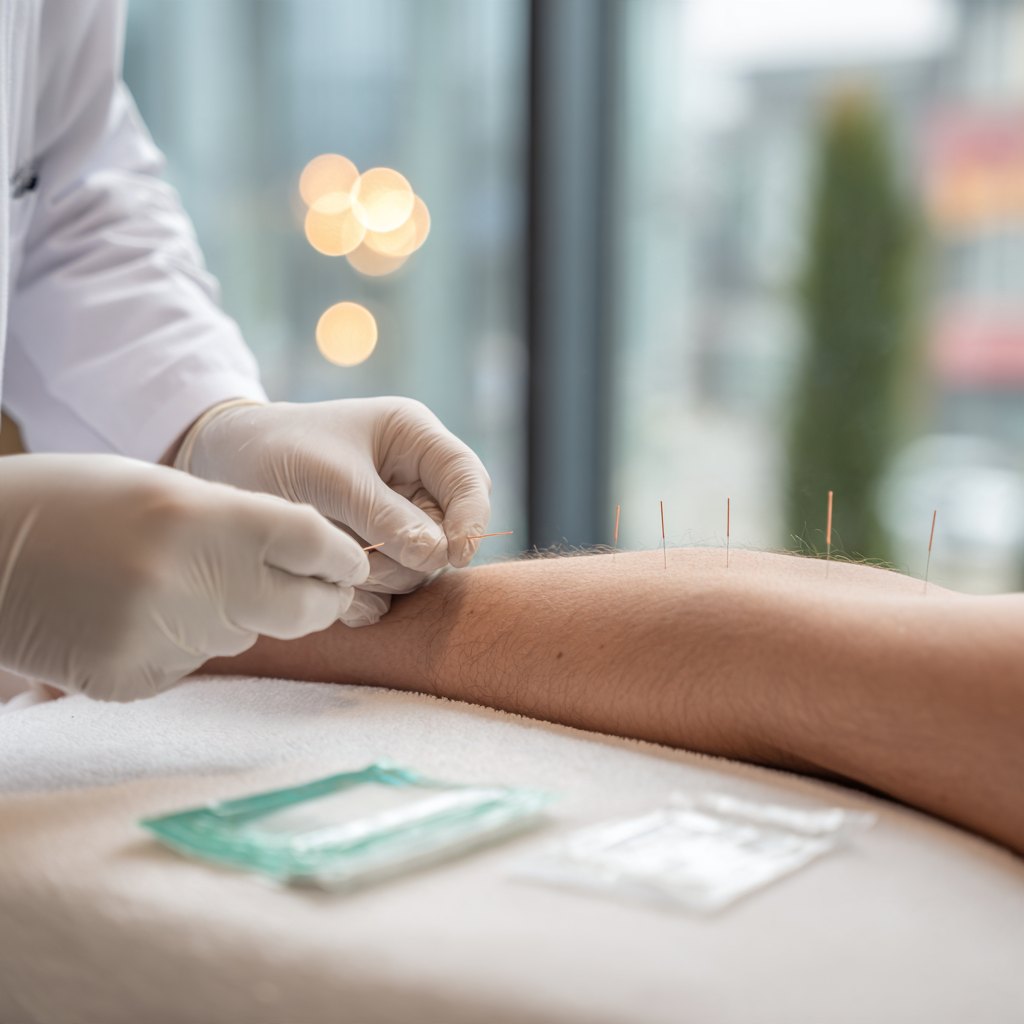
A session lasts 30 to 40 minutes. You lie down comfortably. The needles are sterile, single-use and much finer than injection needles; how many depends on the condition. You feel a brief prick on insertion, then often a sense of heaviness, warmth or tingling. The needles stay in for 20 to 30 minutes. Where useful, the doctor adds gentle electrical stimulation of the needles (electroacupuncture) or heat (moxibustion).
Afterwards you can return to your normal activities. Some people feel tired or relaxed for a few hours.
The course. Usually one session a week, sometimes two in the first weeks, for 6 to 10 sessions. After the first 4 or 5 we review the goal set at the consultation together: if there has been no response we say so and change approach; if the response is good, we can move to maintenance sessions further apart.
What it helps with
Not every indication carries the same weight. We group them like this, and we tell you just as clearly at the consultation.
Where the evidence is strong
- Chronic back, neck and joint pain. The largest analysis available pooled individual patient data from 39 randomised trials, 20,827 people with back pain, neck pain, osteoarthritis, chronic headache and shoulder pain. Acupuncture reduced pain more than usual care without acupuncture and, to a smaller extent, more than sham acupuncture. After one year the effect had declined by only about 15%.
- Chronic sciatica. In a trial published in 2024 in JAMA Internal Medicine, ten sessions over four weeks reduced leg pain from a herniated disc about twice as much as sham acupuncture, with the difference still present after one year.
- Chronic low back pain over 65. In a 2025 trial of 800 older adults, those who received acupuncture more often had a meaningful improvement in disability than those on usual care alone. This matters for people who need to limit anti-inflammatories and opioids.
- Migraine and tension-type headache prevention. According to the 2016 Cochrane reviews, a course of acupuncture at least halves attack frequency in a much larger share of patients than usual care alone, with efficacy in migraine comparable to preventive drugs and fewer people stopping because of side effects.
- Nausea and vomiting after surgery. Stimulation of the PC6 point on the inner wrist was studied mainly by anaesthesiologists: in a Cochrane review of 59 trials and more than 7,600 patients it reduced nausea and vomiting about as well as the most widely used anti-nausea drugs.
Where the evidence is good but more limited
- Chronic pelvic pain in men (chronic non-bacterial prostatitis). A randomised trial of 440 men, published in 2021 in Annals of Internal Medicine, found symptom improvement in 61% of treated patients against 37% with sham acupuncture, sustained at six months. At the Centre this is coordinated with the urologist.
- Nausea during chemotherapy, alongside medication and always in agreement with the oncologist.
- Fibromyalgia and widespread chronic pain, as part of a programme that includes exercise and, where needed, pain management.
Where it can support care, not replace it
Insomnia, tension and stress, functional digestive complaints such as irritable bowel, menopausal hot flushes. Here studies are small or hard to blind. If we discuss it, it is as an addition to a plan already in place.
What we do not offer
We do not offer acupuncture to improve the chances of success of IVF: the largest trial, published in JAMA, found no difference in live births compared with sham acupuncture. And we never use it in place of a diagnosis or a necessary treatment.
The studies, with figures and sources, are covered in our article Acupuncture: what the evidence really says.
Our Team
Dr. med. Nerlep Kaur Rana
FMH Anaesthesiology, Acupuncture TCM (ASA)
Who performs it
Dr. med. Nerlep Kaur Rana, FMH specialist in Anaesthesiology, with the Swiss certificates in Acupuncture and Chinese Medicine (ASA) and in Prehospital Emergency Medicine (SSERM). Since 2017 she has worked as an anaesthesiologist at the Ente Ospedaliero Cantonale, caring for high-complexity patients; during the pandemic she worked in intensive care. She leads advanced simulation training on anaesthetic emergencies and trains clinicians in procedural hypnosis. Pain, local anaesthesia and the management of complications are her daily work. Consultations in Italian, English, French and Spanish. Profile and online booking.
Safety
The largest study of acupuncture performed by doctors followed 229,230 patients. 8.6% reported at least one side effect, almost always a small bruise or bleeding at the needle site; 2.2% needed treatment for it. Serious complications were extremely rare. Symptoms may briefly worsen after the first sessions, then ease.
Safety depends on who performs the session: knowledge of anatomy, sterile needles and the ability to recognise and manage a reaction. An anaesthesiologist does this every day.
Before the session, tell us if you:
- take blood thinners or antiplatelet drugs (not a contraindication, but we adapt points and depth);
- are or might be pregnant (some points are avoided);
- have a pacemaker or defibrillator (no electrical stimulation);
- have a weakened immune system, diabetes or a joint replacement;
- have fainted during injections or blood tests.
We do not needle an area with a skin infection, and we postpone the session if you have a fever.
Cost: when basic insurance pays
In Switzerland acupuncture is covered by compulsory basic health insurance when it is performed by a doctor with a specialist title and the further-training certificate in Acupuncture and Chinese Medicine (ASA), as set out in Article 4b of the Health Care Benefits Ordinance (KLV/OPre). Acupuncture remained a basic insurance benefit even in 2005, when other complementary therapies were removed.
- The deductible and co-payment apply, as for any other medical consultation.
- You do not need supplementary insurance for the medical part, and you do not need a prescription.
- If your insurance model requires a family doctor, an HMO network or telemedicine as first contact, ask for a referral first, as for other specialists. If your family doctor works at the Centre, the referral is done here.
- The tariff sets limits on services within a given period: if a long course would exceed them, we tell you before we start.
Sessions with non-medical therapists are covered only by supplementary insurance, on each insurer’s terms. For patients with private or international insurance we prepare the documentation for reimbursement.
Everything in one Centre
If you need an X-ray, an ultrasound, a blood test or the opinion of an internist, orthopaedic surgeon or urologist, we do it here, often on the same day. The Centre is open Monday to Friday from 8:00 to 20:00 and on Saturday from 8:00 to 17:00, for people who cannot come during office hours. On WhatsApp we also reply in the evening and at weekends.
For referring doctors
We see patients referred by family doctors and specialists, including doctors outside the Centre. At the end of the course, or earlier if something relevant comes up, the referring doctor receives a short report on progress and response. To discuss a case: nerlep.rana@mcsorengo.ch.
Frequently asked questions
Does acupuncture hurt?
The needles are very fine. Most people feel a brief prick and then heaviness or tingling, which fades by the end of the session.
How many sessions will I need?
Usually 6 to 10, once a week. After the first 4 or 5 we review your response together. If there is none, there is no point in continuing, and we tell you.
When will I notice an effect?
Often after 2 to 4 sessions. In headache prevention we compare headache days per month, so it takes a few weeks.
Is it covered by health insurance?
Yes, by basic insurance, because it is performed by a specialist doctor with the ASA certificate. The deductible and co-payment apply.
Do I need a prescription?
No. If your insurance model requires a family doctor or telemedicine as first contact, ask for a referral before the visit.
What is the difference between acupuncture by a doctor and by a therapist?
A doctor can make a diagnosis, recognise when a problem needs something else, and manage medication and complications. The doctor’s service is covered by basic insurance; a therapist’s only by supplementary insurance.
Can I continue my medication and physiotherapy?
Yes. Acupuncture is added to your current care. Whether painkillers can be reduced over time is the doctor’s decision.
Can I have it if I take blood thinners or am pregnant?
Often yes, with some precautions. Tell us before the session.
What should I bring?
Any tests and reports you already have, a list of your medication and your health insurance card. Wear comfortable clothes that can be rolled up on arms and legs.
Main sources
Vickers AJ et al., J Pain 2018;19:455-474. Tu JF et al., JAMA Intern Med 2024;184:1417-1424. DeBar LL et al., JAMA Netw Open 2025;8:e2531348. Linde K et al., Cochrane Database Syst Rev 2016, CD001218 and CD007587. Lee A et al., Cochrane Database Syst Rev 2015, CD003281. Sun Y et al., Ann Intern Med 2021;174:1357-1366. Smith CA et al., JAMA 2018;319:1990-1998. Witt CM et al., Forsch Komplementmed 2009;16:91-97. Swiss Health Care Benefits Ordinance (KLV/OPre), Art. 4b.
Last updated: November 2026.